What Is Rod Power?
Rod power refers to the amount of force required to bend a rod at its designed action point, and it plays a major role in how a rod handles fish, line, and lure weight. Power ratings typically range from ultra-light to heavy, with lighter rods bending more easily and heavier rods requiring more pressure to load.
These ratings are directly tied to a rod’s recommended line and lure range, helping anglers match their setup to the conditions they’re fishing. A common way to choose the right power is by the size of the fish being targeted—lighter power rods are better suited for smaller species like panfish and trout, while medium power rods offer versatility for species like bass. For inshore fishing, especially when targeting redfish, medium-heavy power is often the preferred choice because it provides enough backbone to control strong fish, particularly around structure, while still maintaining sensitivity. In more demanding environments like surf fishing, even heavier power is typically needed to handle larger weights and tougher conditions.
For example, a rod labeled 6’0” Light, 4–8 lb line, 1/16–1/4 oz lure indicates a 6-foot rod with light power, designed to perform best with 4–8 pound test line and lightweight lures between 1/16 and 1/4 ounce. This rating helps ensure the rod loads properly when casting and performs as intended when fighting fish.
It ranges from ultra-light to heavy, and directly affects how the rod handles fish, line, and lure weight.

In simple terms:
- Light power bends easily
- Heavy power requires more force to bend
Common Power Ratings
- Ultra light (UL) → Small fish, finesse techniques
- Light (L) → panfish, trout
- Medium (M) → versatile, general-purpose fishing
- Medium-Heavy (MH) → inshore, bass, redfish
- Heavy (H) → large fish, heavy cover
Why Power Matters
Power determines:
- How much pressure you can apply to a fish
- The size of fish you can handle
- The type of lures you can throw
What Is Rod Action?
What Is Rod Action?
Rod action describes where the rod bends when pressure is applied.
It ranges from slow to extra fast, with slower actions bending deeper toward the handle, and faster actions bending closer to the tip.
The terms “slow” and “fast” don’t just describe where the rod bends—they also reflect how quickly the rod recovers after being loaded. In other words, how quickly it returns to its original position once the pressure is released.
Rod action plays a major role in performance, especially when it comes to casting. When you load a rod during a cast, slower actions tend to handle heavier lures more smoothly because they distribute that load across a larger portion of the blank. Faster actions, on the other hand, are better suited for lighter setups and more precise casting.
Common Action Types
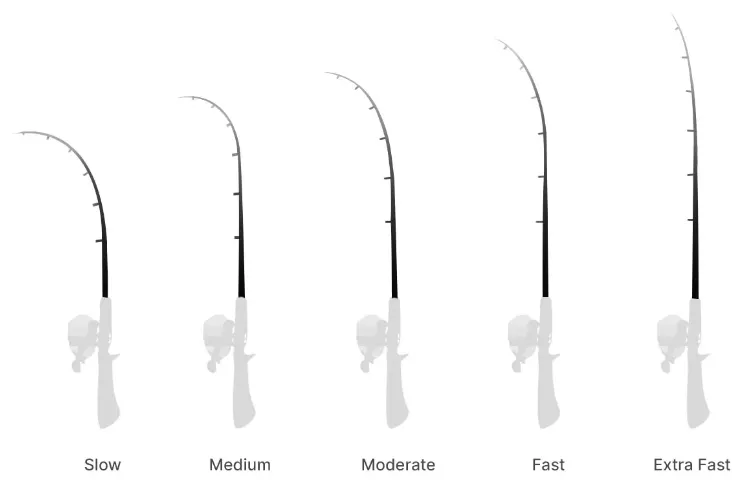
- Slow Action → bends throughout the entire rod
- Moderate Action → bends through the middle
- Fast Action → bends mostly near the tip
- Extra Fast → bends only at the very tip
A fast action rod gives:
- Quick response
- Strong hook sets
- Better feel
A moderate action rod gives:
- More flex
- Better shock absorption
- Smoother fights
Power vs Action: The Key Difference
This is the simplest way to think about it:
- Power = how much it bends
- Action = where it bends
They work together, but they control different aspects of performance.
This is the simplest way to think about it:
- Power = how much it bends
- Action = where it bends
They work together, but they control different aspects of performance.
This is the simplest way to think about it:
- Power = how much it bends
- Action = where it bends
They work together, but they control different aspects of performance.
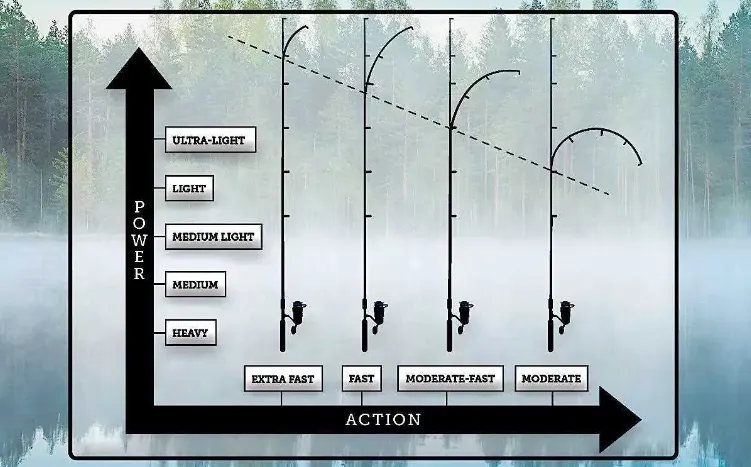
Medium + Fast
- Versatile
- Good sensitivity
- Common all-around setup
Medium-Heavy + Moderate-Fast
- Stronger backbone
- Still flexible enough for fighting fish
- Ideal for inshore fishing
Light + Fast
- Very sensitive
- Great for finesse techniques
Inshore / Redfish:
- Medium-Heavy power
- Moderate-Fast action
Trout / Panfish:
- Light to Medium power
- Fast action
General Use:
- Medium power
- Fast action
Why This Matters More Than Brand Names
Many anglers focus on brand or price, but power and action have a bigger impact on how a rod performs.
Two rods can look similar—but feel completely different on the water depending on how they’re built.
Final Thoughts
Understanding rod power and action gives you more control over your setup and helps you choose a rod that actually matches your fishing style.
Once you dial in the right combination, you’ll notice:
- Better casting
- More consistent hook sets
- More control during fights